 IA· · 2 min
AI Engineering Takes the Lead.
Today, AI is making waves with innovations in robotics, prompt management, and academic collaborations. Key players like OpenAI and Google are pushing boundaries while tackling challenges in model deployment and performance. It's a pivotal moment for AI where engineering meets research.
AI Engineering Takes the Lead
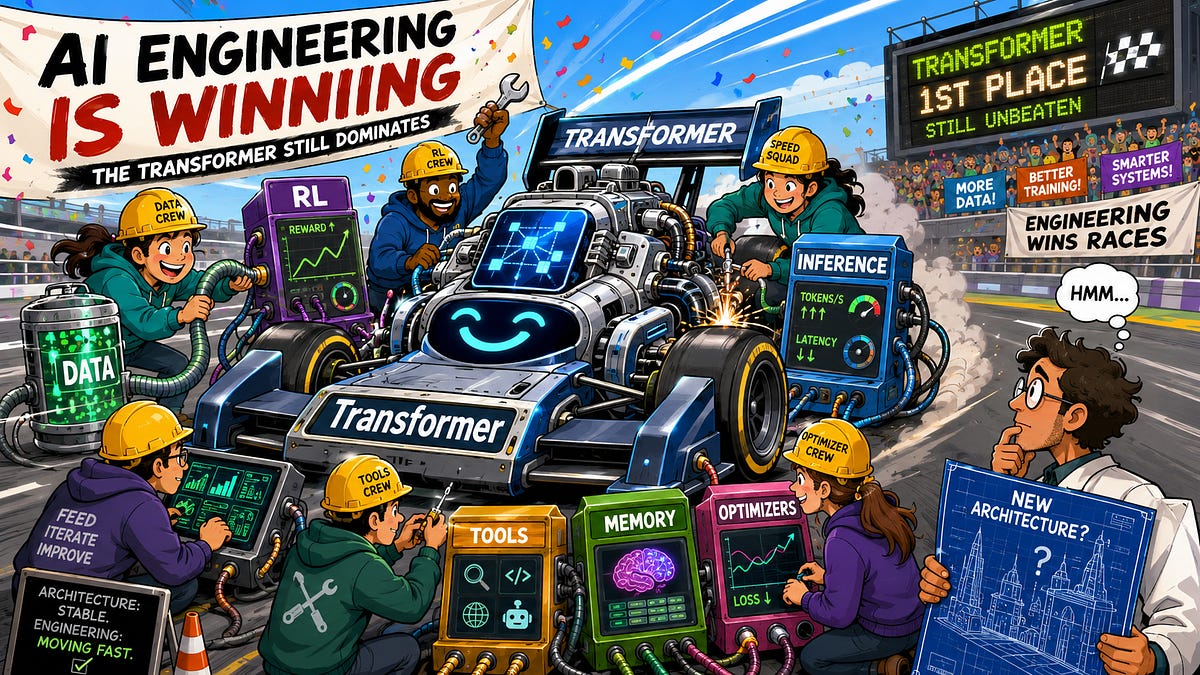
TheOpinion from TheSequence argues that the era of pure research in AI is fading. Instead, we're seeing a shift towards engineering, leveraging existing architectures like Transformers with smarter systems around them. It’s about optimizing what we have to unlock new potentials.
Robotics Meets AI

DeepMind's Gemini Robotics ER 2 is a game-changer for robots, enabling them to understand video inputs and collaborate effectively. This model transforms how robots operate in real-world scenarios, making them smarter and more effective in task execution. It’s a big leap towards practical AI applications in physical environments.
Prompt Management Innovations

OpenAI is enhancing its GPT-5.6 models with new features like explicit prompt caching, allowing for efficient reuse and reduced costs. This innovation is set to revolutionize how businesses deploy AI, making processes faster and more economical. It’s a crucial step for effective AI integration in workflows.
Academic Collaborations Thrive
OpenAI's initiative to provide 100,000 researchers free access to ChatGPT aims to accelerate scientific discovery. This move emphasizes the importance of collaboration in advancing research and highlights AI's role as a catalyst for innovation in academia.
The Creative Edge

DeepMind has launched Lyria 3.5 in Google Flow Music, which enhances musicality and creative control. This model pushes the boundaries of music generation, offering artists new tools to express their creativity. It’s a fresh take on using AI in the creative industries.
Advancing the price-performance frontier with GPT-5.6
OpenAI's latest GPT-5.6 models offer lower pricing and improved efficiency for enterprises. This enables better deployment of AI workflows at scale, addressing critical operational needs.
Deploying Kimi K3 on AWS
Kimi K3, a powerful new model, can be deployed on AWS, allowing organizations to harness its capabilities for complex tasks. This deployment approach is a game-changer for businesses looking to integrate advanced AI.
- How to Organize All of Your Coding Agent TasksManaging tasks with coding agents is becoming increasingly complex. This article offers strategies to streamline workflows. — Towards Data Science
- How to Build a Context Layer and a Company BrainCreating a context layer for LLMs can enhance company knowledge management. This article explores the practical steps. — Towards Data Science
- Echoverse: Deep, evolving environments for computer-use agentsMicrosoft's Echoverse provides dynamic environments for training computer agents, enhancing their learning capabilities. — Microsoft Research
- Avoiding Entity Key Drift in a Data Lake: Step 1, NormalizationThis article discusses the importance of normalization in data lakes to prevent identifier drift. — Towards Data Science
- Why Your Best Predictive Model Gives the Wrong Treatment EffectModel selection often leads to misleading results. This article explains how to refine your approach. — Towards Data Science
- From CUDA to MLX: How K-Search Brings Decades of Kernel Expertise to Apple SiliconThis article discusses the translation of CUDA optimization to Apple Silicon, vital for AI performance. — Berkeley AI Research
Esta edição foi útil?
Um clique basta — isso orienta a próxima.