 AI· · 3分
Revolutionizing Robotics with Memory.
Today's AI and machine learning news is buzzing with innovative advancements and practical applications, from enhancing robot memory systems to empowering local journalism through AI. The integration of AI across sectors like education and customer service highlights a clear trend: organizations are increasingly looking to leverage AI not just for automation, but for creating meaningful, user-centric experiences. As the tech landscape evolves, the race to harness AI's capabilities continues, underscoring the importance of foundational models and intelligent frameworks in driving future developments.
Revolutionizing Robotics with Memory
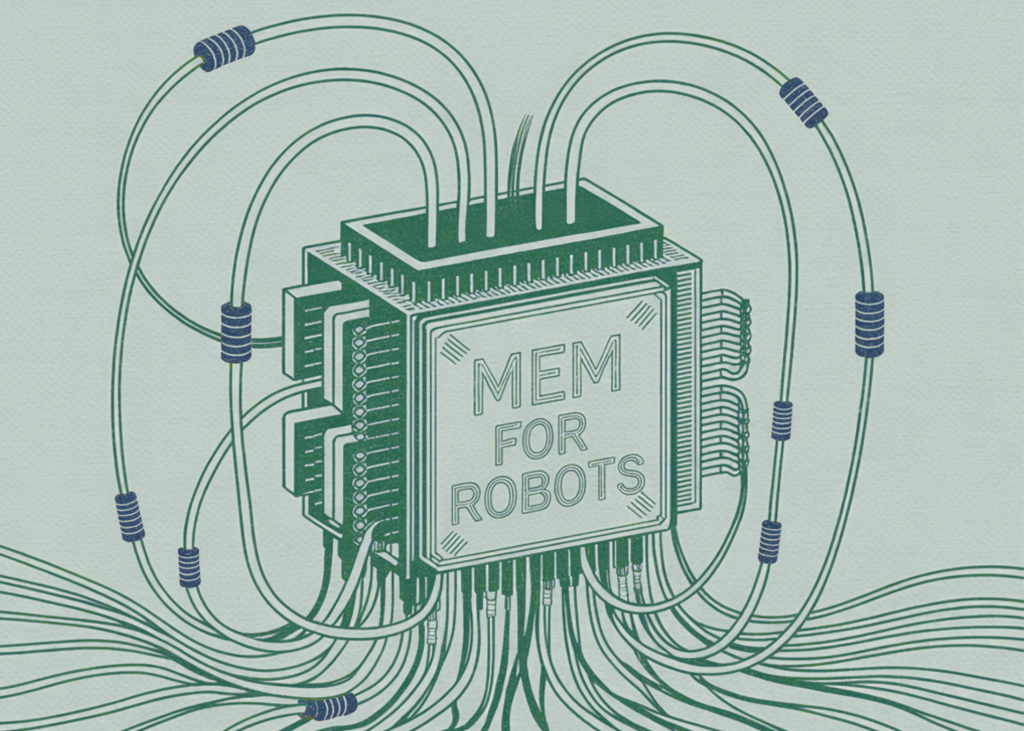
In a groundbreaking development, researchers from Physical Intelligence have unveiled the Multi-Scale Embodied Memory (MEM) system, which enhances robotic capabilities by providing a robust memory architecture. This innovation allows robots to handle complex tasks with a 15-minute contextual memory, potentially transforming how machines operate in dynamic environments. By addressing the traditional limitations of robotic memory, MEM paves the way for more sophisticated AI applications in robotics, enabling more intricate tasks like navigation and interaction in real-world scenarios.
As robots become more adept at understanding and executing long-term tasks, we might see significant shifts in industries reliant on automation. The implications extend beyond mere efficiency; they touch on how we interact with machines and the nature of autonomy in robotics. This development aligns with broader trends in AI, where memory and contextual awareness are becoming central to creating intelligent systems that can learn and adapt over time.
AI in Education: Measuring Learning Outcomes

The education sector is beginning to harness AI's potential with tools that promise personalized learning experiences. OpenAI's recent initiative to develop the Learning Outcomes Measurement Suite aims to quantify AI's impact on student performance over time, moving beyond traditional assessment methods. This approach seeks to fill critical gaps in understanding how AI influences learning processes, fostering a more nuanced view of educational performance in diverse contexts.
As educational institutions adopt these AI-driven tools, they stand to gain insights that could reshape curricula and pedagogical strategies. This trend mirrors a growing acknowledgment of AI's role in empowering both educators and students, illuminating pathways for innovation in teaching methods and learning environments.
Transforming Journalism with AI

Axios is making headlines for its innovative use of AI in local journalism, demonstrating how technology can enhance the quality and efficiency of news delivery. Chief Operating Officer Allison Murphy discussed how AI tools streamline workflows, from story creation to distribution, allowing journalists to focus on high-impact reporting. This reflects a broader trend where media organizations leverage AI for better audience engagement and informative content delivery.
As AI becomes more integrated into journalism, it raises important questions about authenticity and the ethical implications of automated reporting. The need for transparency in AI-generated content is crucial, as the line between human and machine-generated narratives continues to blur. Axios’s model could inspire other news organizations to explore similar avenues, potentially revitalizing local journalism.
Ricoh's new solution is projected to process over 70,000 documents monthly, demonstrating the scalability of AI in document processing.
出典The MEM system allows robots to maintain a context of 15 minutes, significantly enhancing their task execution capabilities.
出典Ricoh's framework decreased engineering hours per deployment by over 90%, showcasing efficiency gains through AI.
出典LangWatch Open Sources the Missing Evaluation Layer for AI Agents
LangWatch is revolutionizing the development of AI agents by introducing a standardized framework for evaluation and simulation. This open-source platform addresses the complexities of non-determinism in AI systems, allowing developers to conduct thorough testing and debugging. By enabling granular observation of agent interactions, LangWatch could significantly enhance the reliability and performance of autonomous systems, pushing the boundaries of what AI can achieve in real-world applications.
How Ricoh Built a Scalable Intelligent Document Processing Solution on AWS
Ricoh's innovative use of AWS for intelligent document processing showcases the potential of generative AI in streamlining complex workflows. By leveraging serverless architecture and AI, Ricoh has reduced onboarding times significantly and increased processing capacity. This case study not only highlights the efficiencies that AI can bring to enterprise operations but also serves as a model for other organizations looking to modernize their document handling processes.
- Extending single-minus amplitudes to gravitonsA preprint that extends single-minus amplitudes to gravitons using GPT-5.2 Pro to derive nonzero graviton tree amplitudes. — OpenAI
- Use Canvas in AI Mode to get things doneGoogle's Canvas in AI Mode offers a dynamic space for organizing projects, now enhanced for writing and coding tasks. — Google
- Escaping the Prototype Mirage: Why Enterprise AI StallsThis piece explores the common pitfalls of AI prototypes in enterprises and why many fail to evolve into actual products. — Towards Data Science
- 5 Useful Python Scripts to Automate Exploratory Data AnalysisAutomate your exploratory data analysis with these five Python scripts designed to streamline data exploration tasks. — KDnuggets
- 5 Ways to Implement Variable DiscretizationAn informative guide on five methods of variable discretization, crucial for modeling and interpretation in data science. — Towards Data Science
- Stop Tuning Hyperparameters. Start Tuning Your Problem.An insightful article emphasizing the importance of defining the right problem over merely tuning hyperparameters. — Towards Data Science
この号は役に立ちましたか?
ワンクリックで次号の改善に役立ちます。