 KI· · 2 Min.
AI Agents Take Center Stage.
Today’s AI landscape is buzzing with innovations, from new model architectures to practical tools for developers. We’re seeing a shift towards more specialized solutions as AI agents mature. It’s all about making AI work smarter, not just harder.
AI Agents Take Center Stage
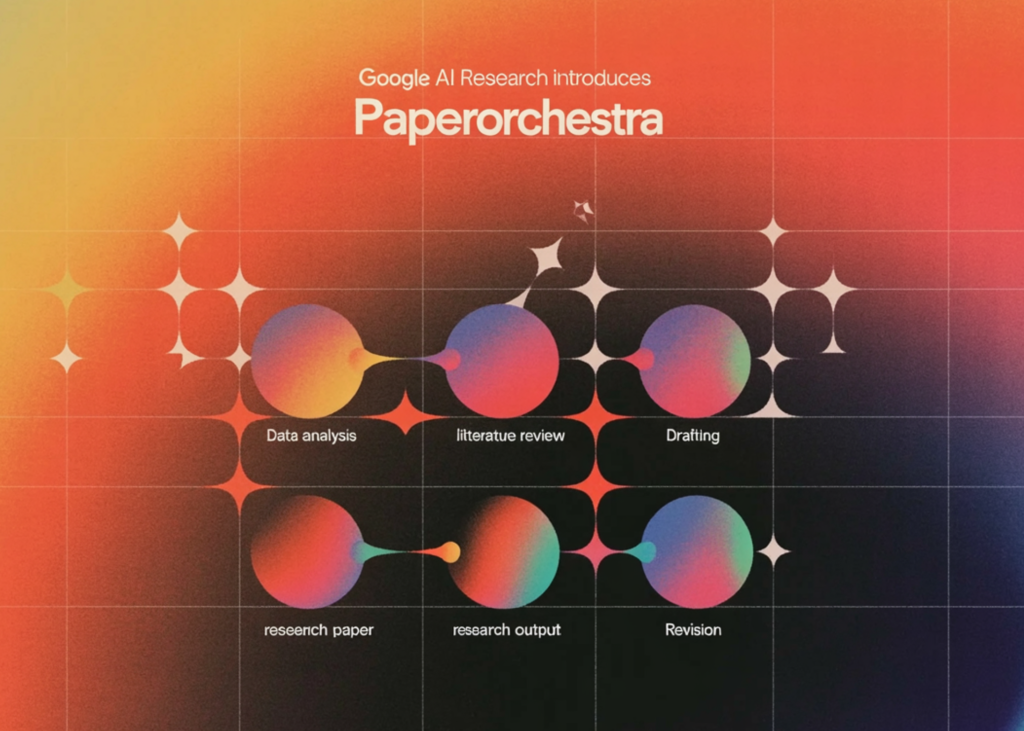
Google has introduced 'PaperOrchestra', a multi-agent framework aimed at automating the often tedious process of writing research papers. This could free up researchers to focus more on experiments rather than paperwork.
Meanwhile, AWS has unveiled the Agent Registry, a tool designed to manage AI agents across organizations. This could simplify the chaos of agent sprawl and streamline collaboration.
Tools for Developers
ModelScope is making waves with its comprehensive guide for model search, inference, and deployment. It's a one-stop-shop for ML practitioners eager to streamline their workflows.
On another front, Google’s Gemini API now allows developers to combine various tools and functions in a single call, enhancing efficiency in app development.
The Shift in AI Startups

As AI evolves, so does the startup landscape. Google’s VP warns about the decline of LLM wrappers, urging startups to build proprietary solutions instead. This shift signals a move towards a more nuanced understanding of AI capabilities.
Startups that leverage specialized AI models are now more desirable, indicating a future where AI technology is more diverse and tailored to specific needs.
Educational Initiatives

Kaggle and Google are teaming up for a free 5-day Gen AI course, giving data professionals a chance to deepen their skills. This initiative is a great opportunity for anyone looking to get hands-on with generative AI.
Additionally, several articles are emerging that break down complex topics like linear regression and survival analysis, making advanced concepts more accessible to everyone.
The number of signups for the Kaggle and Google Gen AI course, highlighting significant interest in AI education.
QuelleThe percentage of AI startup applications Google rejected for being 'shallow wrappers', indicating a shift towards deeper, more substantive solutions.
QuelleThe cost for managing over 1000 replicas with OSGym, showcasing its affordability for AI research.
QuelleMeet OSGym: A New OS Infrastructure Framework
OSGym is an innovative framework designed to manage thousands of computer replicas for AI research at an astonishingly low cost. It tackles the complex infrastructure needs of AI agents operating in real environments.
Understanding Amazon Bedrock model lifecycle
Amazon Bedrock is evolving, introducing new foundation model versions regularly. This post details the model lifecycle, helping developers manage transitions and ensure applications remain effective.
- Sigmoid vs ReLU Activation Functions: The Inference Cost of Losing Geometric ContextThis article dives into the differences between Sigmoid and ReLU activation functions and their impacts on neural network efficiency. — MarkTechPost
- A Coding Guide to Build Advanced Document Intelligence PipelinesExplore how to leverage Google’s LangExtract and OpenAI models for structured extraction in document processing. — MarkTechPost
- How to Combine Google Search, Google Maps, and Custom Functions in a Single Gemini API CallA step-by-step guide on using the Gemini API to combine various Google services in one call. — MarkTechPost
- How to Deploy Open WebUI with Secure OpenAI API IntegrationLearn how to set up Open WebUI with secure OpenAI API access for browser-based chat applications. — MarkTechPost
- The Future of AI for Sales Is Diverse and DistributedA critical look at the evolving landscape of AI startups and the need for specialized models. — Towards Data Science
- Multimodal Embedding & Reranker Models with Sentence TransformersAn update on the Sentence Transformers library, now supporting multimodal capabilities for enhanced AI applications. — Hugging Face
War diese Ausgabe hilfreich?
Ein Klick genügt – er prägt die nächste Ausgabe.